
June 23, 2026
What Electrical Work Is Needed for a Granny Flat?
Building a granny flat involves far more than selecting a floor plan and finishes. Electrical planning can affect how safe, efficient and practical the space will be for future occupants. From confirming the available power supply to planning lighting, power points and data connections, each decision can influence the comfort and functionality of the finished dwelling. Working with an experienced electrician in Wollongong can help ensure these requirements are considered early, reducing the likelihood of costly changes later in the project.
Allround Electrical outlines the key electrical considerations for a granny flat. Addressing these requirements before construction begins can support a smoother build process, reduce the risk of unnecessary alterations and help ensure the electrical installation is suitable for the intended use of the space.
Confirm the Power Supply and Metering Setup
The available power supply and metering arrangement should be assessed before electrical work begins. This helps determine whether the existing property supply can support the additional load and how electricity usage will be monitored or billed.
The assessment typically starts at the existing main switchboard and meter position before considering the proposed submain cable and granny flat sub-board. The electrician will need to account for the Wiring Rules, the NSW Service and Installation Rules and the requirements of the local electricity distributor.
For many Wollongong properties, the electricity distributor is Endeavour Energy. If the existing supply needs to be increased or altered, additional approvals and work by an appropriately accredited service provider may be required.
Check the Existing Supply Capacity
The first step is to assess whether the current electricity supply can support the additional load created by the granny flat. The likely demand will depend on the appliances, heating and cooling systems and hot water arrangement planned for the dwelling.
The electrician will generally consider:
- Whether the property has a single-phase or three-phase supply
- The capacity and condition of the existing main switchboard
- Available space for additional circuit protection
- The expected load from the main home and granny flat
- Whether the existing consumer mains and service connection are suitable
- The distance and cable route between the main switchboard and the granny flat
The load assessment should account for fixed appliances and likely day-to-day use, including cooking, hot water, air conditioning, laundry appliances, lighting and general power.
Where the existing supply is not sufficient, the project may require changes such as a switchboard upgrade, larger consumer mains or an altered network connection. Property owners considering these changes may also benefit from reviewing when a consumer mains upgrade may be required.
The NSW Government provides further information about installing or altering the electricity supply to a property, including when an Accredited Service Provider may be required.
In some cases, changing from single-phase to three-phase power may also be considered. The appropriate solution will depend on the property and the proposed electrical load rather than the floor area of the granny flat alone.
Decide How Electricity Usage Will Be Measured
The metering arrangement should be considered early, particularly where the granny flat may be rented separately from the main home.
Several options may be available:
- A shared electricity account for the main home and granny flat
- A private check meter or submeter used to monitor the granny flat’s consumption
- A separately metered retail connection with its own National Metering Identifier (NMI) and electricity account
A shared electricity account may suit a granny flat used by family members where there is no need to calculate separate usage charges. However, it can make it difficult to determine how much electricity each dwelling consumes.
A private check meter can provide visibility over the granny flat’s electricity usage while the dwelling remains connected through the main property supply. This is not automatically the same as having a separate retail electricity account.
A separate retailer-managed connection may provide the granny flat with its own meter, NMI and electricity bill. This can be useful where the dwelling will be rented independently. However, the appropriate arrangement will depend on the property, the tenancy arrangement and the requirements of the electricity distributor, electricity retailer and metering provider.
Property owners planning to rent a granny flat should obtain advice about the metering arrangement before construction begins. In NSW, whether the premises are separately metered can affect responsibility for electricity usage charges under rental laws. The NSW Government provides further information about electricity charges and separate metering in rental properties.
Plan the Meter Position and Switchboard Arrangement
The physical arrangement of the meters and switchboards should be considered before construction work limits the available options.
The electrician will need to assess:
- Whether the existing meter panel can accommodate the proposed arrangement
- Whether the main switchboard requires upgrading or replacement
- The proposed location of the granny flat sub-board
- How the submain cable will run between the main switchboard and the granny flat
- Whether trenching or underground conduits will be required
- Access for future inspection, testing and maintenance
- The required circuit protection and isolation arrangements
Where the existing switchboard has limited space, older protective devices or an impractical location, it may also be worth reviewing when a switchboard upgrade or relocation may be required before construction progresses.
Where underground cables are required, the cable route should be coordinated with plumbing, stormwater and other underground services before excavation begins. Planning the route early can help avoid unnecessary trenching, damage to completed landscaping and clashes with other trades.
Plan Circuits for Appliances, Heating, Cooling and Hot Water
Electrical planning for a granny flat involves more than adding a few extra power points. The electrician must design circuits that can support the appliances and systems installed in the dwelling without overloading the supply or causing avoidable nuisance tripping.
Each circuit must be sized and protected appropriately for its intended use. This requires consideration of the equipment specifications, cable route, installation conditions and applicable electrical requirements.
Identify High-Load Appliances Early
Fixed appliances with significant electrical loads often require dedicated circuits. The exact requirements will depend on the selected products and their manufacturer specifications.
Examples may include:
- Electric ovens and cooktops
- Split-system air conditioners
- Electric hot water systems
- Dishwashers
- Clothes dryers
- Washing machines
- Electric heaters
- Underfloor heating
These decisions should be made before the electrical rough-in stage. Selecting a different cooktop, hot water system or air conditioner late in the project can change the required circuit capacity and may affect the suitability of the overall power supply.
Instantaneous electric hot water systems require particular attention. Some models have high electrical demands and may not be suitable for the existing property supply or proposed granny flat submain. This should be assessed before the hot water system is selected.
Plan General Power and Kitchen Circuits
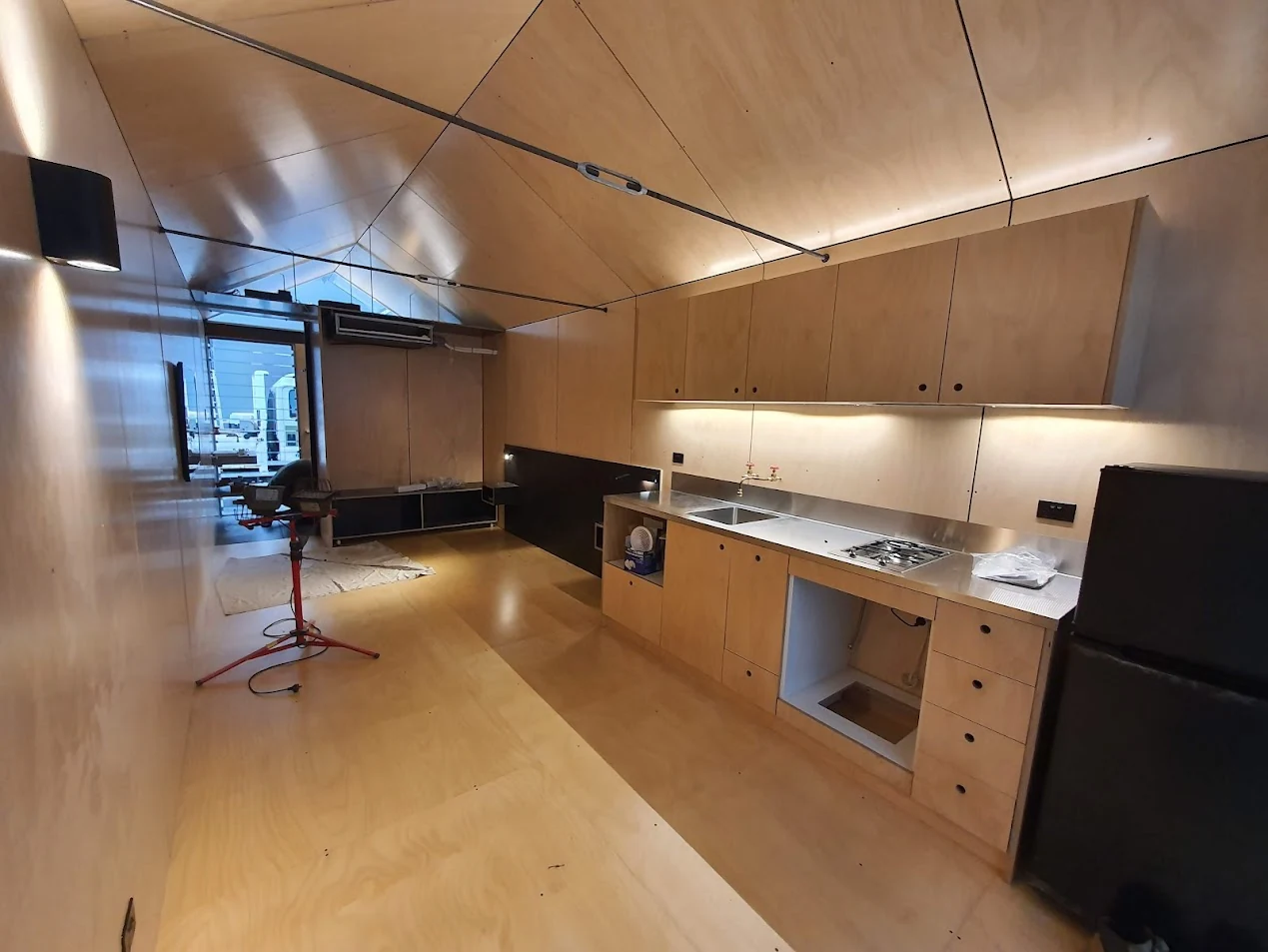
Power points should be grouped across suitable circuits so that typical daily use does not overload one part of the installation. Kitchens require careful planning because several appliances may be used at the same time.
Common kitchen appliances include:
- Refrigerator
- Microwave
- Kettle
- Toaster
- Coffee machine
- Dishwasher
- Rangehood
- Benchtop appliances
The electrician will determine whether separate circuits are required for fixed appliances and how general-purpose outlets, commonly referred to as GPOs, should be distributed across the kitchen and living areas.
Laundry planning is also important. A washing machine and clothes dryer can create a substantial combined load, particularly when other appliances are operating at the same time.
Consider Heating and Cooling Requirements
Heating and cooling systems can form a significant part of a granny flat’s electricity usage. The electrical design should be based on the selected equipment rather than assumptions about what a small dwelling will need.
A split-system air conditioner will generally require a suitable circuit and an isolating switch positioned in accordance with the installation requirements. If more than one system is planned, the electrician should assess the load and circuit arrangement for each unit.
Other heating systems may also need to be considered, including:
- Electric panel heaters
- Heated towel rails
- Bathroom heating
- Underfloor heating
- Additional heating or cooling for a home office
Planning these items early can help ensure the supply and circuit design remain suitable during periods of higher demand.
Review the Hot Water System Options
The choice of hot water system can affect both energy use and electrical capacity.
Common options include:
- Electric storage hot water systems
- Heat pump hot water systems
- Instantaneous electric hot water systems
- Gas hot water systems, where suitable services are available
An electric storage or heat pump hot water system may require a dedicated circuit. Depending on the property and electricity plan, a controlled-load arrangement may also be considered.
The electrician, builder and plumber should confirm the hot water system early so the appropriate electrical supply, circuit protection and installation location can be planned before construction progresses.
Decide Where Power Points, Switches and Lighting Should Go
The position of power points, switches and lighting should be planned before wiring begins. A practical layout can make the granny flat easier to live in and reduce reliance on extension leads, power boards and double adaptors.
A room-by-room plan should consider furniture placement, fixed appliances and the likely needs of future occupants.
Plan Power Points Around Daily Use
Power point locations should suit the way each room is expected to function.
In the living area, consider:
- Power points near the television and entertainment unit
- Data points for streaming devices or a smart television
- Additional outlets near seating for lamps and chargers
- A suitable location for a modem, router or Wi-Fi access point
- An outlet near a desk if the area may be used for work or study
In bedrooms, consider:
- Double power points on each side of the bed
- An additional outlet near a desk or dressing table
- A suitable position for a television, where required
- Future use of mobility aids or medical equipment
In the kitchen, consider:
- Dedicated outlets for fixed appliances
- Accessible benchtop outlets for small appliances
- Appropriate separation from sinks and other wet areas
- The position of the refrigerator, microwave, dishwasher and rangehood
- Whether an appliance cupboard or charging drawer is planned
In a laundry or combined bathroom and laundry, consider:
- Outlets for the washing machine and dryer
- The location of the hot water system, where relevant
- Suitable wet-area clearances
- An accessible outlet for small appliances where appropriate
Outdoor areas may also require weatherproof outlets for equipment such as garden tools, electric barbecues or outdoor lighting. These outlets should be selected and positioned for the conditions in which they will be used.
Position Switches for Practical Access
Light switches should be easy to reach when entering and moving through the granny flat.
Consider:
- A convenient light switch near the main entrance
- Switches positioned near bedroom doorways
- Two-way switching for hallways, stairs or multiple entry points where useful
- Bedside switching where accessibility is a priority
- Separate controls for bathroom lighting, exhaust fans and heating
- Sensor lighting near outdoor paths, steps and entrances
Switches and power points in bathrooms and other wet areas must be positioned to meet the applicable requirements. In some layouts, bathroom switches may be installed outside the room for convenience or to simplify compliant placement.
For older occupants or people with limited mobility, larger rocker-style switches and accessible mounting positions may make the dwelling easier to use.
Use Layered Lighting Throughout the Granny Flat
A combination of general, task and ambient lighting can make a compact dwelling more functional and comfortable.
General lighting may include ceiling-mounted fittings or downlights that provide broad illumination across living areas, bedrooms and walkways.
Task lighting can support activities that require more focused visibility, such as:
- Under-cabinet lighting above kitchen benchtops
- Mirror lighting in the bathroom
- Reading lights near beds
- Lighting above a desk or study area
- Exterior lighting near entrances and steps
Ambient lighting, such as dimmable fittings or wall lights, may provide a softer option for living and bedroom areas.
Lighting should also be selected and positioned with energy efficiency, glare and long-term maintenance in mind. Outdoor fittings require suitable weather protection for their location.
Include Smoke Alarms and Electrical Safety Features
Smoke alarms, safety switches and suitable circuit protection are essential parts of a granny flat’s electrical design. These items should be planned early rather than treated as minor additions at the end of the build.
The requirements that apply to a new granny flat should be confirmed with the electrician, builder and certifier.
Confirm the Smoke Alarm Requirements
Smoke alarms are compulsory in NSW residential buildings where people sleep. For new building work, the applicable requirements are determined by the National Construction Code and the approval pathway for the project.
At a minimum, alarms need to be positioned to protect sleeping areas and installed on each level of the dwelling. Where bedrooms are connected by a hallway, alarms are generally positioned in the hallway near the sleeping areas. Where there is no hallway, an alarm is generally positioned between the sleeping area and the remainder of the dwelling.
Where multiple smoke alarms are required, they should be interconnected so that when one alarm detects smoke, the other alarms sound as well. The certifier and electrician should confirm the type of alarms, power supply and interconnection requirements that apply to the project.
Fire and Rescue NSW recommends a higher level of protection than the minimum requirement, with interconnected alarms in bedrooms, living areas, hallways, stairways and garages. Including additional alarms during construction can be more practical than retrofitting them later.
Smoke alarms should be positioned in accordance with the manufacturer’s instructions and kept away from locations that may affect their performance, such as dead air spaces or areas too close to kitchens and bathrooms.
Install Safety Switches and Circuit Protection
Safety switches, also known as residual current devices or RCDs, help reduce the risk of electric shock by disconnecting the electricity supply when leakage current is detected.
Circuit breakers protect wiring from overloads and short circuits. In many residential installations, RCBOs are used because they combine RCD and circuit-breaker protection for individual circuits.
Individual circuit protection can make it easier to isolate a fault and reduce the likelihood that an issue on one circuit will interrupt electricity supply across the entire granny flat.
The electrician can also advise whether surge protection is appropriate for the property and the equipment being installed.
Plan Internet, TV and Data Connections
Reliable internet access is important for streaming, work, study and smart-home devices. Data cabling is easiest to install while walls are open, so it should be planned alongside the electrical work.
Good planning can reduce reliance on weak Wi-Fi signals and visible surface-mounted cables after the granny flat is complete.
Decide How the Granny Flat Will Connect to the Internet
The most appropriate connection method will depend on the layout of the property, the intended use of the granny flat and the available internet service.
Common options include:
- Extending the existing internet connection using hard-wired data cabling
- Improving Wi-Fi coverage using suitable access points or a wireless bridge
- Investigating whether an additional internet service can be provided
A hard-wired data connection from the main house is often a reliable option. It can support a data point or small network hub within the granny flat and may provide better performance than relying on the existing Wi-Fi signal alone.
A separate nbn connection is not automatically available for every granny flat. Where the granny flat shares the same address as the main home, a new nbn network connection may not be possible. In many cases, the existing service needs to be extended from the primary residence.
Where an additional service is being considered, the property owner should confirm the available options with the internet provider and a registered cabler before trenching, conduit installation or wall lining begins.
Include Hard-Wired Data Cabling
Structured data cabling is relatively straightforward to install during construction but can be difficult to retrofit after walls are lined.
Useful data point locations may include:
- Behind the primary television
- Near a study desk
- In a bedroom that may be used as a home office
- Near the planned router or network equipment
- At an accessible central location for a Wi-Fi access point
A registered cabler should complete telecommunications cabling work where required.
Consider Television and Media Connections
Television requirements should be discussed during the electrical rough-in stage.
Depending on the needs of the occupants, the plan may include:
- A television antenna point in the living area
- An additional television point in a bedroom
- Data cabling for smart televisions and streaming devices
- Suitable power points behind a wall-mounted television
- Conduits for future cabling changes
For many households, a reliable data connection near the main television is more useful than multiple antenna points. The best arrangement will depend on how the granny flat is expected to be used.
Coordinate Electrical Work With the Build Timeline
Electrical work should be coordinated with the overall granny flat construction schedule. Delays or changes at one stage can affect other trades and create unnecessary rework.
The electrician, builder and other contractors should confirm key electrical decisions before excavation, slab preparation and wall lining begin.
Complete Early Planning Before Construction Starts
Before construction begins, the electrician should review:
- The available electricity supply
- The proposed metering arrangement
- The main switchboard and meter position
- The location of the granny flat sub-board
- The route for underground cables or conduits
- The expected load from cooking, hot water, heating and cooling
- The position of fixed appliances
- Power point, lighting and switch locations
- Data and television cabling requirements
Where underground electrical services are required, trenching should be coordinated with plumbing, stormwater and other services. This can help avoid clashes and reduce the need to disturb completed driveways, paths or landscaping later.
Coordinate the Rough-In Stage
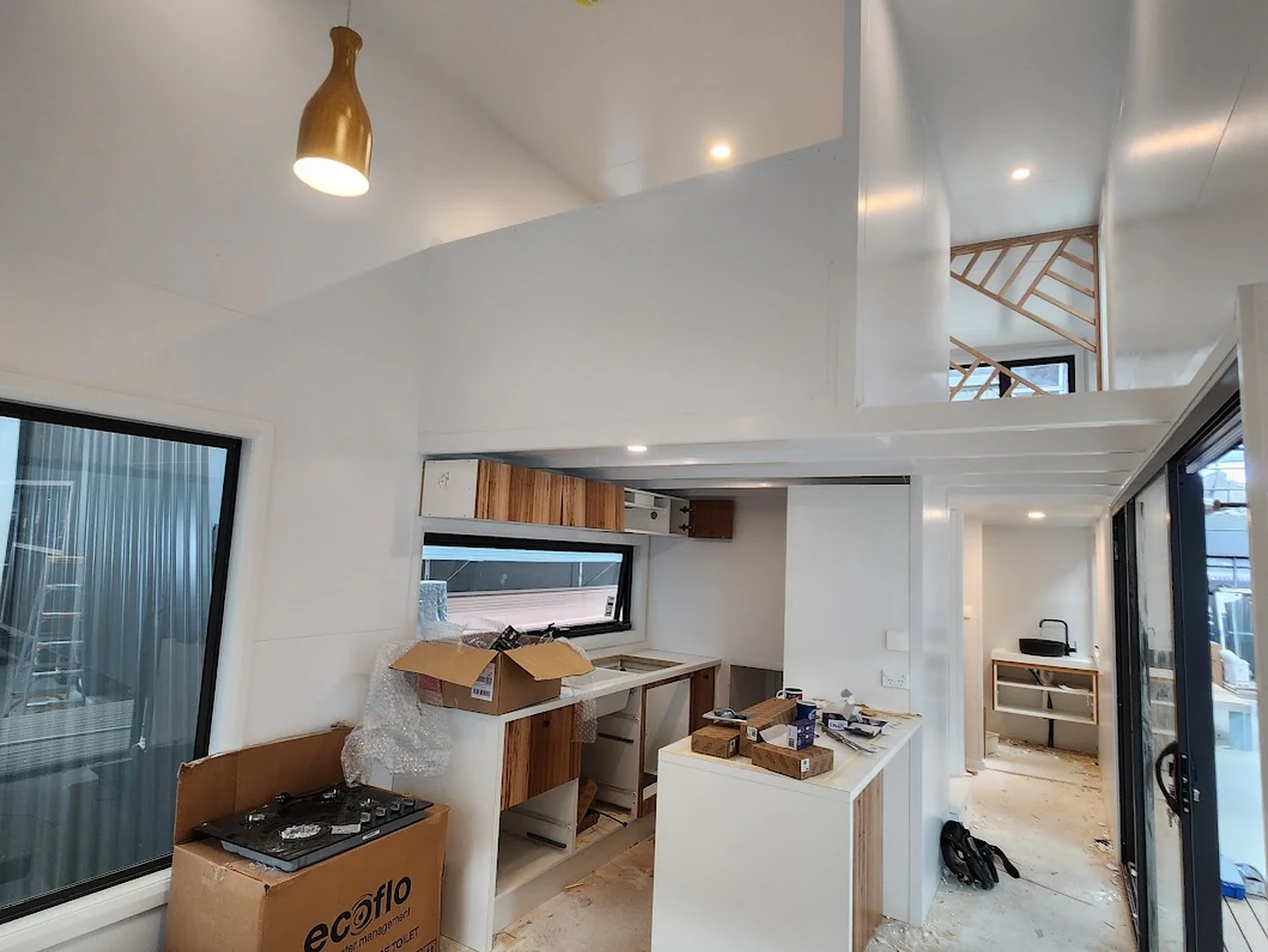
Electrical rough-in generally occurs once the frame is complete and before insulation and internal wall linings are installed.
At this stage, the electrician installs the cabling and prepares the positions for:
- Power points
- Light switches
- Lighting
- Appliances
- Exhaust fans
- Smoke alarms
- Data points
- Television outlets
- The granny flat sub-board
Selections should be confirmed before rough-in wherever possible. Late changes to cabinetry, appliances or room layouts can require additional labour and may affect the electrical design.
Coordinate Fit-Off With Interior Work
Electrical fit-off occurs after wall linings and other interior finishes are sufficiently complete.
The electrician will generally return to install and connect items such as:
- Power points
- Switches
- Light fittings
- Exhaust fans
- Appliances
- Smoke alarms
- Data and television outlets
- The granny flat sub-board
Cabinetry, tiling and painting should be coordinated carefully so the electrician has appropriate access to complete the work efficiently.
Complete Testing and Compliance Documentation
Before handover, the electrician must test the electrical installation and confirm that the completed work is safe and compliant.
Testing will generally include:
- Safety switches and circuit protection
- Earthing
- Circuit operation
- Switchboard labelling
- Smoke alarm operation
- Fixed appliances and equipment
- Isolation switches where required
The licensed electrician responsible for the work must complete the required Certificate of Compliance for Electrical Work. Any additional building approval, certification or occupancy requirements should also be coordinated with the builder and certifier.
Plan the Electrical Requirements Before Construction Begins
Electrical planning is one of the most important parts of a successful granny flat project. Confirming the supply capacity, metering arrangement, switchboard requirements, circuits, lighting, power points and data connections early can help create a safe and functional dwelling.
Early planning can also reduce the risk of construction delays, compliance issues and costly alterations after walls, pathways or landscaping are complete. By coordinating the electrical requirements with the wider build, property owners can achieve a reliable outcome that supports the long-term use of the granny flat.